Bus and coach operators software, from booking to boarding
A web booker, a dispatch console, a driver app and a passenger app with QR boarding — plus your own routes, your own fares and live seat occupancy.
What is bus and coach operator software?
Bus and coach operator software manages group and per-seat bookings, your own routes and fares, vehicle and driver dispatch, seat occupancy and passenger boarding in one system. Shuttle.Software (by ElevateCode Digital LLC, Wilmington DE) combines a web booker, dispatch console, driver app, passenger app and QR boarding. Plans start at $99 per month with 0% commission.
Coach, minibus and shuttle companies sell seats on fixed routes and charter whole vehicles on the same day. Shuttle.Software runs both from one board: customers book on your branded web booker, dispatchers assign the right vehicle and driver, drivers run the trip from their own phones, and passengers follow the vehicle live and board with a QR code. You set the routes, you set the fares, and seat counts update with every booking.
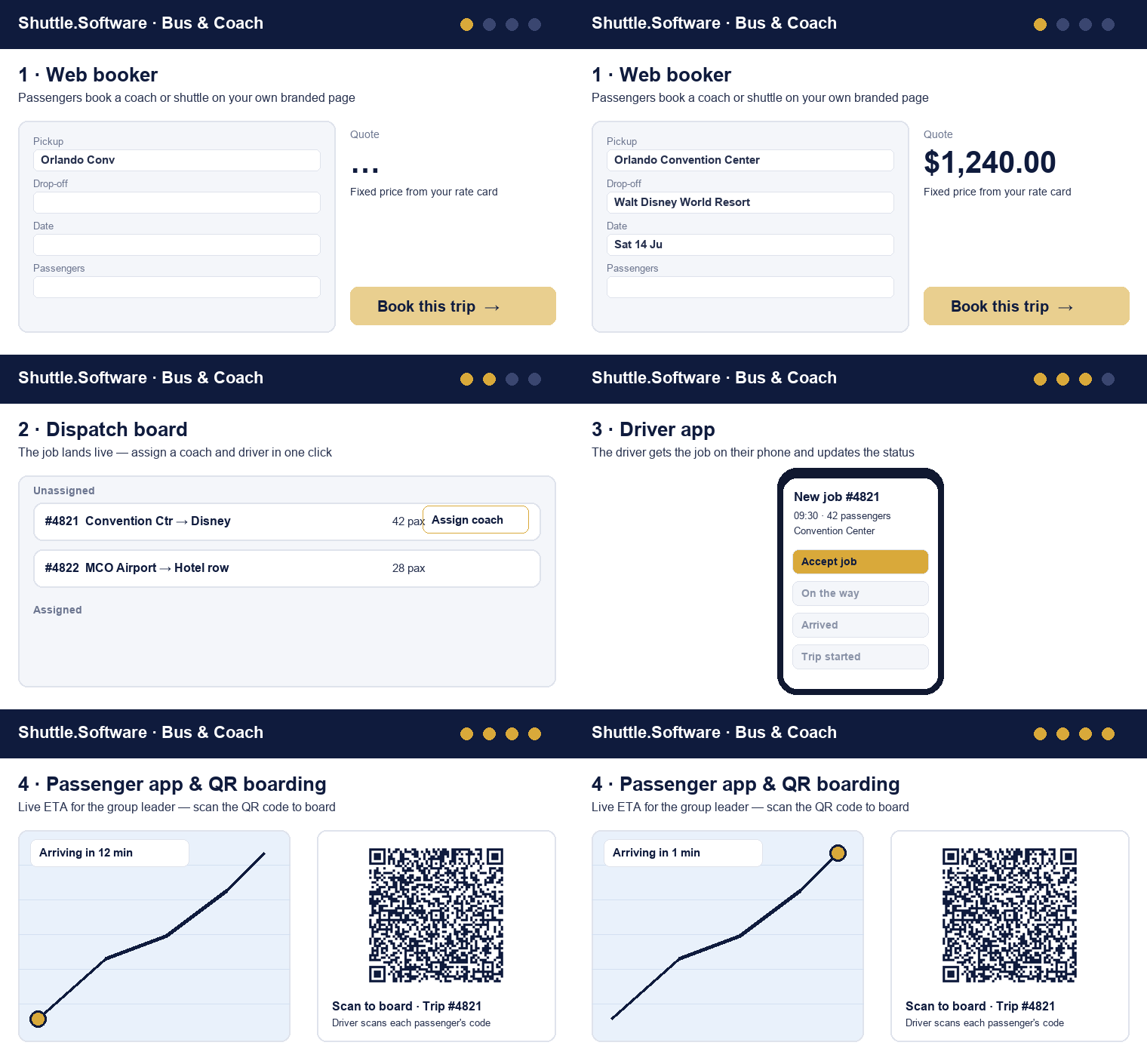
The dispatch console and the three apps
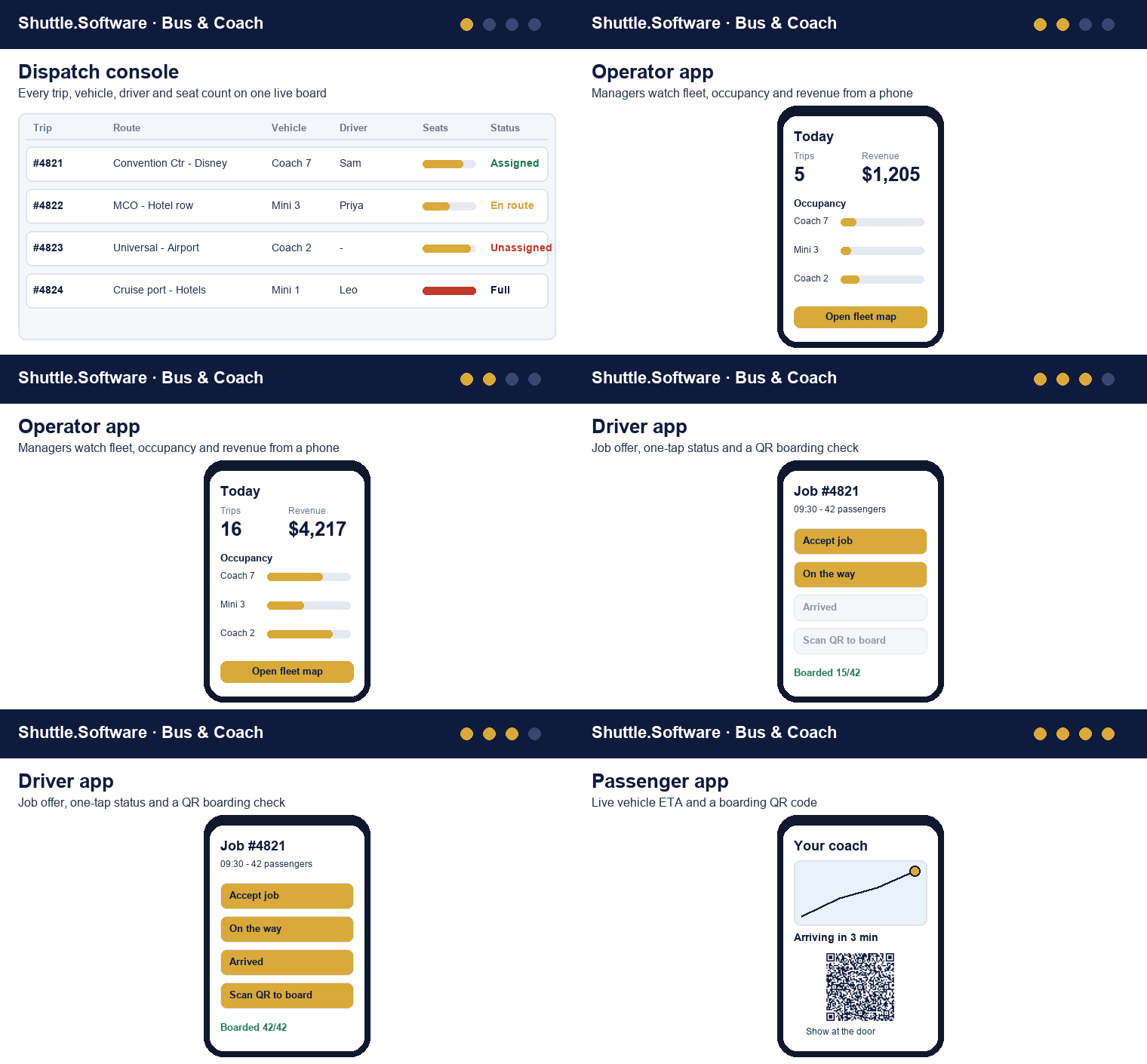
Run your own routes, fares and seats
Own route management
Build your own routes with named stops, pickup and drop-off points. Set timetables for scheduled shuttles, add charter and event trips, create return legs and multi-stop itineraries, and reuse a route for recurring or contract work.
Own fares
Set your own price per route, stop-to-stop leg, vehicle class or flat charter rate. Separate fares for adults, children, groups and accounts, night and holiday rates, and extras. The customer sees a fixed quote and the money goes to your own payment account.
Occupancy management
Every vehicle has a seat capacity, and seats sold and seats left update with each booking. The booker stops selling when a run is full, the board shows load at a glance, and QR check-in compares who boarded against who booked.
The economics of running a bus business
A useful way to see why a bus operator needs the right software is the cost and revenue picture of the business itself. This is an English translation and adaptation of the Hindi case study “The Economics of Owning a Bus Business” by HinExp. Its figures are for the Indian market, converted to US dollars at roughly ₹85 = $1 and rounded. Treat them as illustrative, not as advice.
What a bus costs
- A standard Tata or Ashok Leyland sleeper coach costs roughly $70,000–$95,000.
- A premium Volvo 9600 sleeper starts around $175,000 on the road. Volvo sells the chassis only, so the owner pays separately for the body, seats, washroom and pantry.
- On a loan, one Volvo can carry a monthly instalment of about $3,000 or more, before a single wheel turns.
Two ways a bus earns
- Your own route, your own passengers: you keep the fares. The video quotes about $4,100–$4,700 of monthly profit for a good bus on a good route at only 250 km a day, and 20–22 buses at about $3,500 each take in roughly $70,000 a month. The upside is high and so is the risk.
- A per-kilometre contract with a state transport body: the owner supplies the bus, two drivers and maintenance and is paid a fixed rate per kilometre (about $0.53 per km for a Volvo in the example). The client pays fuel and tolls. Revenue is guaranteed: a 700 km/day contract pays for 700 km even if the bus ran 600, full or empty.
- Larger operators often split the fleet between the two.
Online booking and commission
- Booking apps usually reach the owner through a booking system that publishes buses, seats and routes to many platforms.
- Each platform keeps a commission, often around 15%. On a $12 ticket about $1.80 goes to the platform and $10.20 to the owner.
- Agents in other cities also sell seats for a per-seat commission, which is why passengers on one bus can pay different prices.
Where the money goes
- Diesel is the biggest cost: about 3–4 km per litre, so a 500–600 km night at roughly $1.06 per litre is on the order of $130–$210 in fuel (our arithmetic from the video’s figures).
- Staff: long routes need two drivers, plus meals and allowances.
- Maintenance: tyres, engine, brakes and air conditioning add up to thousands of dollars. Insurance, tax and driver pay alone can reach $1,500–$1,750 a month for a large bus.
- An idle bus still costs money: instalments, insurance and salaries continue, so keeping seats sold is everything.
Permits, tax and safety
- An operator needs the driver’s licence, vehicle registration, tax and a permit. An All India Tourist Permit (about $1,050 in the video) plus home-state base tax lets one bus run across states without border taxes.
- The video warns against shortcuts such as cheap local wiring or misdeclaring an AC bus as non-AC to save tax: they are illegal and linked to fire accidents. Save money everywhere except on safety.
The verdict, and what it means for your software
Returns can be high and daily results are visible, but fixed costs are heavy and an empty bus is the biggest risk. A careful operator picks routes well, keeps some buses on steady contracts, tracks every rupee and never compromises on safety.
- Empty seats are the risk: live occupancy shows under-filled runs early so you can merge them or promote the seats.
- Commission eats margin: your own web booker sells seats at your own fares, with 0% commission.
- Per-kilometre contracts need records: dispatch and tracking give you the kilometres and trips to bill.
- An idle bus is a loss: the dispatch console shows which vehicles are unassigned today.
How this looks in the USA and Europe
The same economics apply anywhere: heavy fixed costs, fuel and drivers as the biggest running costs, and an empty seat as the biggest risk. What changes is the vehicle price, the rules and how work is sold.
| India (from the video) | USA | Europe | |
|---|---|---|---|
| Typical vehicle | Sleeper coach roughly $70,000 to $175,000+ | New full-size motorcoach roughly $450,000–$700,000; minibus or shuttle bus roughly $80,000–$200,000 | New coach roughly €250,000–€450,000; minibus roughly €60,000–€150,000 |
| How operators earn | Own routes, or per-km state contracts | Charter and group trips, airport and hotel shuttles, school and corporate contracts, scheduled intercity routes | Charter and tour work, school and public-transport tenders, scheduled and franchise routes |
| Marketplace commission | Around 15% on booking platforms | Varies by marketplace; direct bookings keep the full fare | Varies by platform; some brands run on a revenue share with the operator |
| Operating rules | AITP permit, state tax, GST | USDOT number and FMCSA operating authority for interstate passenger carriers, commercial driver's licence, hours-of-service logs | Operator licence (Community licence for international work, PSV licence in the UK), EU drivers' hours rules and tachograph |
| Cost pressure | Diesel, two drivers, EMI | Fuel, insurance, driver wages and driver shortage, maintenance | Fuel and tolls, driver wages, low-emission-zone and electrification costs, VAT |
Figures for the USA and Europe are indicative ranges from general industry knowledge, not from the video. Prices, rules and commissions vary by state, country and platform, so check them locally before you plan.
USA
Most coach and shuttle revenue is charter, airport, hotel and contract work sold directly to groups, so your own web booker, quotes and invoices matter more than a marketplace. Occupancy and empty (deadhead) miles decide the margin.
Europe
A mix of tour and charter work, school and public tenders and branded scheduled routes. Tender and contract work is paid on agreed kilometres or hours, so accurate trip, distance and driver-hours records are what you bill from.
Everywhere
Price from your own rate card, keep seats sold, keep vehicles assigned and keep a record of every trip.
Scan to see it on your phone

Point your phone camera at the code to open the demo request. The same kind of code appears on each booking so the driver can scan passengers on board.
Features built for this operation
Web booker
Your branded booking page with group size, vehicle class, date and stops, a fixed quote and card payment.
Dispatch console
Every trip, vehicle, driver and seat count on one live board, with unassigned runs flagged early.
Driver app
Run offers, one-tap status and navigation handoff on the driver's own phone.
Passenger app
Live vehicle position and ETA, trip updates and a boarding QR code.
QR boarding
The driver scans each passenger's code and the manifest shows who boarded against who booked.
Own routes
Named stops, timetables, return legs, multi-stop itineraries and charter trips.
Own fares
Fares by route, leg, vehicle class or passenger type, with night, holiday and extras.
Occupancy management
Seat capacity per vehicle, seats sold and left, a full-run stop and an optional waitlist.
From booking to drop-off in four steps
Book
The customer requests a seat or a whole coach on your web booker and sees a fixed price.
Dispatch
The run appears live on the console; you assign a vehicle and driver.
Drive
The driver accepts and updates the trip from the driver app.
Board
Passengers follow the live ETA and show their QR code at the door.
What changes in week one
Fuller vehicles
Live occupancy shows under-filled runs to merge and full ones to upsize.
✓ Live in 3–5 working daysNo double-sold seats
Every channel sells from the same live seat count.
✓ Live in 3–5 working daysFewer calls to the office
Passengers see the vehicle and ETA themselves.
✓ Live in 3–5 working daysYour fares, your money
Fares come from your own rate card with 0% commission.
✓ Live in 3–5 working daysWho this is for
Charter coach and minibus companies · Airport, hotel and attraction shuttle operators · School, church and corporate contract transport · Tour operators running scheduled and ad-hoc transfers
Frequently asked questions
What is bus and coach operator software?
It is the system a coach or shuttle company uses to take group and per-seat bookings, price them from its own rate card, assign a vehicle and driver, track the trip live and settle payment. Shuttle.Software puts the web booker, dispatch board, driver app and passenger app in one flat-priced platform.
Can I dispatch coaches, minibuses and shuttles from one board?
Yes. Each vehicle carries its own seat capacity and class, so a 14-seat minibus and a 55-seat coach are matched to the right run. Unassigned or over-capacity runs are flagged before they go late.
Can I set up my own routes and fares?
Yes. You build your own routes, stops and timetables and set your own fares by route, stop-to-stop leg, vehicle class or passenger type. Fares come from your rate card and every fare stays yours.
How does occupancy management work?
Each vehicle has a seat capacity. Seats are counted down as bookings arrive, so every run shows seats sold and seats left, and the booker stops selling when the vehicle is full. The driver app shows the passenger count for each run.
How does the QR code work?
Each booking can show a QR code in the passenger app or on the confirmation. The driver scans it at boarding to check the passenger on, and the manifest updates live.
Do drivers need special hardware?
No. The driver app runs on a modern Android or iOS phone. Drivers accept runs, tap through on-the-way, arrived and trip-started, and check passengers on with QR.
How much does it cost?
From $99/month flat for 1–3 vehicles with a one-time $399 setup and 0% booking commission. There are no per-trip or per-passenger fees.
See it running on your routes
20-minute personalised demo loaded with your city, routes and rate sheet before the call.