Best Shuttle Booking Software in 2026: 10 Platforms Compared (Vendor-Published, Listed Alphabetically)
There is no single best shuttle booking software — there is the right one for your fleet size, your mix of shared-ride and private work, and how much of your revenue arrives through your own website. This review covers ten platforms used by airport, hotel, campus and employee shuttle operators in 2026, with published pricing where it exists, what each one is genuinely good at, and where it breaks down. We build one of them (Shuttle.Software, by ElevateCode Digital LLC in Wilmington DE), so this is a vendor-published review: the platforms are listed alphabetically rather than ranked, every price links back to the vendor's own published pricing page, and the best-fit recommendation is made per operator type at the end rather than at the top.
How did we compare these platforms, and who wrote this?
Every platform below was assessed against the six things a shuttle operator touches every single day, rather than a feature list nobody reads. We use the following criteria to discuss suitability, not to produce a ranked score:
Criteria: per-seat inventory, dispatch, flight awareness, driver experience, acquisition and total cost over 12 months. Platforms are listed alphabetically; no independent numeric scores or top-spot claims are presented.
Disclosure: this review is published by Shuttle.Software (by ElevateCode Digital LLC, Wilmington DE), which builds one of the ten platforms below. Because a vendor ranking itself first is worth nothing to you, the platforms are listed alphabetically rather than in a ranked order, and the best-fit call is made per operator type at the end. Descriptions draw on vendor documentation and linked published pricing. Prices labelled September 2026 were checked then and must be reconfirmed before purchase; this is not independent product testing. Where a vendor publishes no price, we say so rather than guessing. Screenshots below are from the current Shuttle.Software release — the dispatch board and the customer-facing booking widget — so you can see the two screens this whole category is judged on.
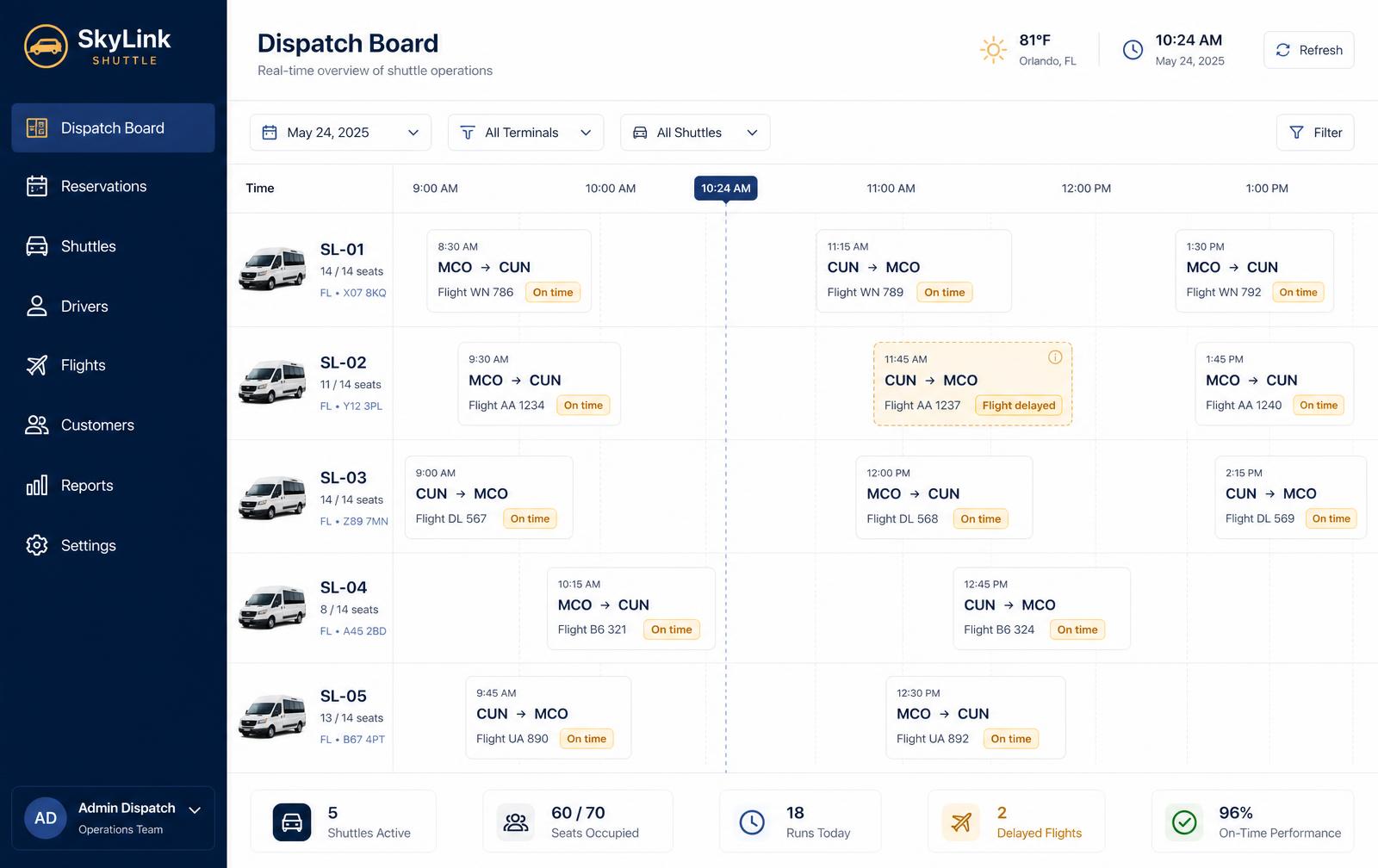
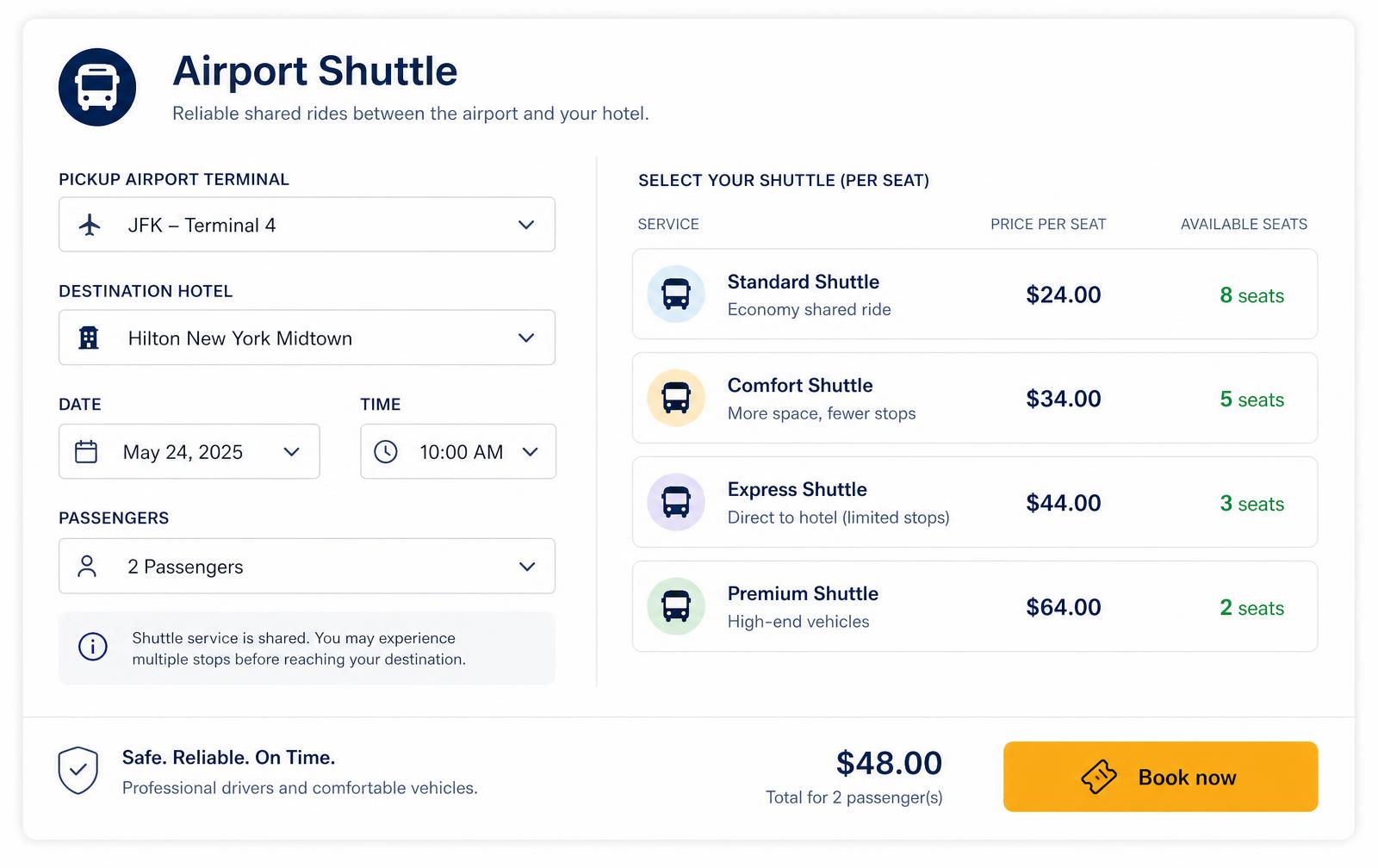
- Per-seat inventory: can one 8-seat van sell 8 separate seats with live capacity, or is the vehicle the booking unit?
- Dispatch: is there a real board for assigning runs and reassigning vehicles mid-shift?
- Flight awareness: does a delayed arrival move the pickup time and notify the passenger automatically?
- Driver experience: a phone app with the manifest, navigation handoff and QR boarding, usable with no training.
- Acquisition: does the platform bring you direct bookings (website, SEO, widget), or is that your problem?
- Total cost: monthly price, setup, per-driver fees and booking commission across a full year, not just the sticker price.
AllRide Apps — best if you want a customised build
Pricing: custom quote plus multi-thousand-dollar setup; go-live in weeks to months.
A capable shuttle and bus platform sold as a build-and-brand project, including branded rider apps. Genuinely flexible if you have a bespoke feature set in mind and the budget to specify it.
Where it breaks down: the timeline. Operators who need to be selling seats next week are the wrong buyer, and change requests are billed rather than shipped.
Deeper dive: the AllRide Apps alternative page covers pricing, gaps and how a migration works, and the Shuttle.Software vs AllRide Apps page is the full side-by-side table.
Hudson HGTS — best for enterprise shared-ride networks
Pricing: custom enterprise quote, annual contract, implementation measured in weeks or months.
Hudson's Ground Transportation System is the category's reference implementation for shared-ride: consolidation logic for complex shared-ride operations, plus extensive rate, coupon, voucher and loyalty machinery. If you run a large multi-market operation and your rate card is genuinely complicated, this is the benchmark.
Where it breaks down: for a 5-van operator, the procurement cycle and implementation cost dominate the decision, and routes and rates are vendor-configured rather than self-serve.
Deeper dive: the Hudson HGTS alternative page covers pricing, gaps and how a migration works, and the Shuttle.Software vs Hudson HGTS page is the full side-by-side table.
Jugnoo — best multi-vertical mobility suite
Pricing: custom enterprise quote plus setup.
If you are launching taxi, delivery, auto-rickshaw and shuttle services under one roof, a suite makes sense and Jugnoo covers that breadth with a long track record.
Where it breaks down: shuttle is one vertical among many, so per-seat depth — zone pooling, manifests, flight-linked pickups — is shallower than a shuttle-only product.
Deeper dive: the Jugnoo alternative page covers pricing, gaps and how a migration works, and the Shuttle.Software vs Jugnoo page is the full side-by-side table.
Limo Anywhere — best affiliate network, shuttle as a module
Pricing: the published CORE plan starts at $99/mo plus $0.25 per trip and a $299 upfront fee, scaling with monthly trip volume, with paid add-ons for flight tracking and website/SEO — verified against Limo Anywhere's own pricing page in September 2026.
The most established black-car platform in the market, with a farm-in/farm-out affiliate network to evaluate. Shuttle support arrives through an add-on module.
What to verify: test the Shuttle Module with your actual shared-ride runs and confirm module costs, dispatch steps and website inclusions directly with Limo Anywhere. We do not assign a review consensus without linked evidence.
Deeper dive: the Limo Anywhere alternative page covers pricing, gaps and how a migration works, and the Shuttle.Software vs Limo Anywhere page is the full side-by-side table.
Moovs — best polished platform for mixed fleets
Pricing: published plans run $149/mo, $199/mo (plus a $299 setup fee) and $499+/mo enterprise, with per-vehicle add-on charges — verified against Moovs' own pricing page in September 2026.
Moovs is genuinely well-built software with a modern interface, a solid driver app, live tracking and a clean customer-facing booking flow. For operators running black car alongside shuttle work, the breadth is an advantage.
What to verify: ask Moovs to demonstrate your per-seat routes, flight-delay handling and driver workflow, and confirm which app and website features are included in the quoted tier.
Deeper dive: the Moovs alternative page covers pricing, gaps and how a migration works, and the Shuttle.Software vs Moovs page is the full side-by-side table.
Rezdy — best OTA distribution for tour-shaped shuttles
Pricing: subscription plus channel commission on marketplace and OTA resale.
Rezdy's distribution network is the reason to use it: if resellers, hotels and OTAs drive your volume, few systems connect you to more of them.
Where it breaks down: it is a tours-and-activities platform. There is no dispatch board, no driver assignment and no flight tracking, so airport work is managed in notes fields — and marketplace commission eats into a $45 seat.
Deeper dive: the Rezdy alternative page covers pricing, gaps and how a migration works.
Shuttle.Software — best for 1–30 vehicle shuttle operators
Pricing: $99/mo (1–3 vehicles), $199/mo (4–12), $349/mo (13–30), with respective one-time setup fees of $399, $499 and $699. 0% booking commission, unlimited bookings, live in 3–5 working days.
Shuttle-first by design: the seat is the atomic unit, so every departure carries live capacity that the booking widget, the back office and the dispatch board read from one source. Airport bookings poll airline status and shift the driver's manifest automatically when a flight slips. The driver app runs QR boarding offline. An SEO booking website with local landing pages, schema and an llms.txt AI-visibility kit is included in the price rather than sold as an add-on.
Where it is not the answer: multi-market enterprise operators who need advanced loyalty tiers, complex voucher ecosystems or airport-authority reporting will find Hudson HGTS deeper. Published plans cover 1–30 vehicles; fleets of 31+ need an Enterprise quote and agreed scope.
ShuttleControl — best for crew, campus and terminal shuttles
Pricing: published plans are $108/mo (3 vehicles), $208/mo (6 vehicles) and $460/mo (15 vehicles) billed annually, plus add-ons — verified against ShuttleControl's own pricing page in September 2026.
The newest name on this list, focused on managing internal and contracted shuttle operations — staff moves, terminal loops, campus routes — with a clean operations layer.
Where it breaks down: it manages shuttles rather than sells them. Public per-seat sales, payments and the acquisition side (website, SEO) are largely outside its scope.
Deeper dive: the ShuttleControl alternative page covers pricing, gaps and how a migration works, and the Shuttle.Software vs ShuttleControl page is the full side-by-side table.
TransferVista — best for private transfer and chauffeur operators
Pricing: tiered SaaS with per-driver seat fees.
Well-executed transfer and chauffeur software with good airport handling and a competent widget, suited to operators whose core product is a private A-to-B transfer.
Where it breaks down: shared-ride per-seat booking is an add-on rather than the core unit, and per-driver pricing penalises seasonal hiring.
Deeper dive: the TransferVista alternative page covers pricing, gaps and how a migration works, and the Shuttle.Software vs TransferVista page is the full side-by-side table.
Zaui — best for scheduled sightseeing and shuttle-bus hybrids
Pricing: quoted by booking volume and modules.
A mature reservation system with strong reseller tooling and good manifest handling for scheduled departures, widely used by sightseeing and transport operators in North America.
Where it breaks down: no airline feed and limited dispatch, so delayed pickups and mid-shift reassignment stay manual.
Deeper dive: the Zaui alternative page covers pricing, gaps and how a migration works.
Which shuttle booking software should you choose?
Match the platform to the shape of your business rather than to the longest feature list:
- 1–30 vehicles, airport or shared-ride, most bookings direct: Shuttle.Software.
- 50+ vehicles, multi-market, complex loyalty and vouchers: Hudson HGTS.
- Black car first, shuttle second: Moovs or Limo Anywhere.
- Most volume from OTAs and resellers: Rezdy or Zaui.
- Internal crew, campus or terminal shuttles only: ShuttleControl.
- You want to own a bespoke platform: AllRide Apps, Mobility Infotech or a custom build.
Three questions worth asking every vendor
Before you sign anything, ask these on the call and get the answers in writing:
- What is my total cost in month 13 — including setup, per-driver fees, add-ons and any booking commission?
- Show me, live, what happens to a manifest when the inbound flight is 40 minutes late.
- How do I export my customers, reservations and rate tables if I leave, and does that cost anything?
Frequently asked questions
What is the best shuttle booking software in 2026?
There is no single winner — the best platform depends on fleet size and whether shared-ride is your core product. For airport and shared-ride operators running 1–30 vehicles, Shuttle.Software (published by ElevateCode Digital LLC, the vendor behind this review) fits well: per-seat capacity, dispatch, driver app with QR check-in, automatic flight-delay handling and an SEO booking website at $99–$349/mo flat with a one-time $399 setup and 0% commission. Large enterprise networks are better served by Hudson HGTS, and mixed black-car fleets by Moovs or Limo Anywhere.
How much does shuttle booking software cost?
Small-operator SaaS typically runs $99–$500 per month on published pricing (Limo Anywhere from $99/mo plus per-trip fees, ShuttleControl $108–$460/mo, Moovs $149–$999/mo). Shuttle.Software is $99–$349/mo plus a one-time $399 setup with 0% commission. Enterprise platforms such as Hudson HGTS are custom-quoted and usually reach five figures in year one, and custom builds commonly land at $6,000–$20,000 upfront plus a maintenance retainer.
What is the cheapest shuttle booking software?
Self-hosted booking scripts are cheapest upfront, but they exclude dispatch, driver apps and flight tracking, and you host and patch them yourself. Among full platforms, $99/month flat with 0% commission is the low end of the market.
Which shuttle software handles flight delays automatically?
Shuttle.Software and Hudson HGTS re-time pickups from live airline status. Moovs offers partial flight tracking; Rezdy and Zaui have no airline feed at all.
Do I need shuttle-specific software, or will a booking platform do?
If you only sell scheduled, tour-shaped departures from one meeting point, a booking platform can work. As soon as you run airport pickups, hotel zones and shared vans that get reassigned mid-shift, you need per-seat capacity, dispatch and flight tracking — that is what shuttle-specific software adds.
How long does it take to switch shuttle platforms?
With Shuttle.Software, 3–5 working days including free migration of customers, reservations, vehicles, routes and rate tables. Enterprise implementations and custom builds typically take weeks to months.
Ready to move?
Shuttle.Software plans start at $99/mo with a one-time $399 setup and 0% booking commission — live in 3–5 working days.
Request a guided demo →Or explore the full shuttle booking software product page →